Although Congress and the press have failed to do their jobs and stop Trump’s march to dictatorship, and the Supreme Court appears to be shaky, the lower courts have been doing a magnificent job.
Statistics show that Trump and his administration suffered a 96 percent loss rate in federal courts in May, and politics had little or nothing to do with it. Some of Trump’s appointees joined in as 72.2 percent of Republican-appointed judges and 80.4 percent of Democratic-appointed judges ruled against the administration.
In addition, about 180 judicial rulings have at least temporarily paused some of the administration’s initiatives, and the administration is winless thus far in court cases concerning punishments the president has tried to inflict on law firms.
The sub-supreme courts are clobbering him in major ways, and especially so last week. A quick recap lest we forget:
- A three-judge panel (including two Republicans, one a Trump appointee) at the U.S. Court of International Trade ruled that most of Trump’s tariffs are illegal. It said the Constitution gives Congress the exclusive power to impose tariffs, and it gave Trump 10 days to comply.
- U.S. District Judge Tanya Chutkan ruled that 14 states can proceed with their lawsuit against billionaire Elon Musk and the so-called “Department of Government Efficiency”, saying that their conduct is “unauthorized by any law.” (Russell Vought, director of the Office of Management and Budget, is pushing to make the DOGE cuts to government permanent.)
- U.S. District Judge Richard Leon struck down Trump’s executive order targeting the law firm WilmerHale because the firm employed Robert Mueller, the special counsel who investigated the ties between Trump’s 2016 presidential campaign and Russian operatives. Leon wrote, “[T]he First Amendment prohibits government officials from retaliating against individuals for engaging in protected speech. WilmerHale alleges that ‘[t]he Order blatantly defies this bedrock principle of constitutional law.’ I agree!”
- U.S. District Judge Paula Xinis denied the administration’s motion for a 30-day extension of the deadline for it to answer her questions regarding Kilmar Abrego Garcia, the Maryland man sent to El Salvador through what the administration said was “administrative error.” The motion came on the same day the answers were due.
Trump will not go down easily. His standard response to court rulings is to appeal everything, and he’s doing that now. But now he’s taking it much deeper. He’s closely following what political scientist Adam Bonica describes the script that authoritarians around the world followed to success.
- Courts rule against the leader.
- The leader attacks the judges as biased and dangerous.
- The leader delegitimizes the judicial system.
- The leader creates permission for threats against judges.
- If no mass resistance follows, the leader purges the courts.
- If mass resistance follows, the leader is forced to retreat.
Leading that list is attacks on judges. Hear these recent words from Trump and those in his administration after courts ruled against him:
- “USA HATING JUDGES WHO SUFFER FROM AN IDEOLOGY THAT IS SICK.”
-Trump, writing on Truth Social after a court blocked him from quickly carrying out deportations. Later, he said that following the Constitution “would completely destroy Presidential Power.” - “We are living under a judicial tyranny”, and it’s a “judicial coup.”
-Stephen Miller, White House deputy chief of staff, written on social media after a three-judge panel blocked Trump from using most of his tariffs. - “Three judges of the U.S. Court of International Trade disagreed and brazenly abused their judicial power” (and) “moved to usurp the authority of President Trump to stop him from carrying out the mandate that the American people gave him.”
– Karoline Leavitt, the White House press secretary, commenting on the court’s ruling on tariffs.
Ms. Leavitt also made the administration’s legal strategy clear: Get as many contested cases as possible to the Supreme Court, which has a conservative majority including one Trump appointee, and “hope that the Supreme Court will weigh in and rein them in.” (The high court has not collapsed to Trump yet, but it’s given us reasons for concern. It gave him freedom to break the law at will, and it ruled late last week that Trump may temporarily (!) deport 500,000 legal immigrants whom President Biden had protected for humanitarian reasons.)
Another way Trump is showing his disdain for the courts — and in this instance the courts can do nothing about it — is to pardon people whom the courts have convicted of major crimes.
And in doing so he openly parades his corruption. He pardoned Paul Walczak, a former nursing home executive who pleaded guilty to tax crimes in 2024, after Walczak’s mother donated at least $1 million to him. The pardon spares Walczak from 18 months in prison and $4.4 million in restitution.
He even commuted the sentence of Larry Hoover, a former Chicago gang leader serving a life sentence at a supermax prison in Colorado. Hoover was first imprisoned in connection with a murder in 1973, and he was convicted of running a criminal drug enterprise in 1998. Trump did that despite his promise to use capital punishment against drug dealers.
I won’t even get into his pardoning people who were convicted of crimes involved with raiding our Capitol in a riot that he fomented, a riot that caused physical damage, injuries and deaths. But by pardoning them and several others, Trump openly and brazenly displays an eagerness to pardon prominent Republicans and other supporters, donors and friends.
Next on Bonica’s script comes creating permission for threats against judges. Trump and his administration are doing that by personalizing their attacks on judges who rule against them, such as Miller’s posting photos of the three judges alongside his online diatribe against them. Why else would he post their photos other than to stir up anger against them and make them more easily identifiable in public?
The ploy is working. Threats against federal judges have risen drastically since he took office. The New York Times obtained internal data compiled by the U.S. Marshals Service that show that 80 judges had received threats during a five-month period leading up to March 1 of this year, and then 162 received threats over the next six weeks.
But there is at least one important caveat to what Trump is doing. New York Times columnist Thomas Friedman says Trump is taking a political risk by declining to obey court orders for him to return Abrego Garcia to U.S. soil, and to turn around deportation flights. He says Americans historically don’t take well to presidents who violate court orders.
“Historically, and certainly in the last century, presidents have not done well politically by defying the courts,” he writes. “People might support the president’s agenda, but they balk at presidents ignoring the courts.”
We’ll see. We’re getting down to the 5th and 6th steps in Bonica’s description of the authoritarians’ script, and they are crucial. Essentially, if We the People don’t react with massive resistance, Trump will purge the courts and will rule them. But if we do react with massive resistance, Trump retreats.
It can happen. It happened in Israel in 2023 when Benjamin Netanyahu’s coalition tried to destroy judicial independence. People from all parts of society took to the streets. A broad and nonpartisan group came together to defend democracy and resist authoritarianism. And they won.
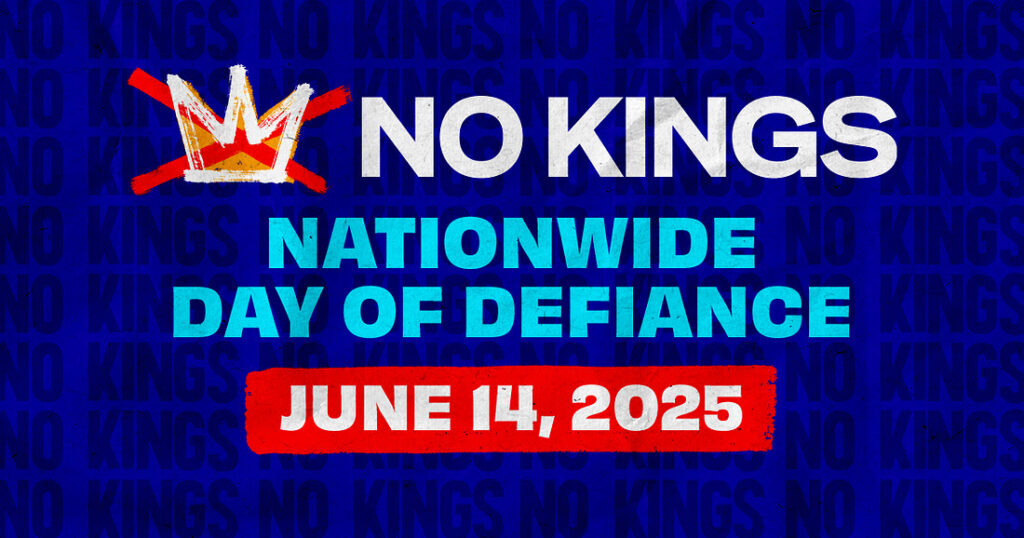
It can happen here. It must happen here. I am confident it will happen here, because it already is happening here. An impressive 5 million-plus people turned out for the Hands Off rally last April 5, and I expect a lot more than that will show up on No Kings Day June 14 – the same day Trump is giving himself a multi-million-dollar a military parade as a birthday present, just like other authoritarians do.
All we need to do is turn out, speak up, and never, never give up. And we will win.
- America’s courts versus Donald Trump
- A Trade Court Stopped Trump’s Tariffs. Why Didn’t Congress?
- Federal Court Vs. Trump Administration: The Legal Battle Begins
- Trump’s clash with the courts raises prospect of showdown over separation of powers
- Trump’s anti-climate orders draw lawsuit from young activists citing life, liberty
- PBS sues Trump administration over executive order targeting public broadcasting


Great essay, Skip. I am right there with you on the judiciary. I do think the sub-SCOTUS federal judges are protected by the traditional constitutional precedents they are obliged to uphold and that SCOTUS, the ultimate interpreter (Under Marbury v. Madison) of “what the law is,” doesn’t have that protection from Executive fury. I keep hoping that SCOTUS will come up with a series of landmarks hitting the ball (and Trump) right out of the ballpark.
Interesting that Garcia is back (facing charges) after all. And as usual, Trump is changing the headline, now out their besieging poor LA!!