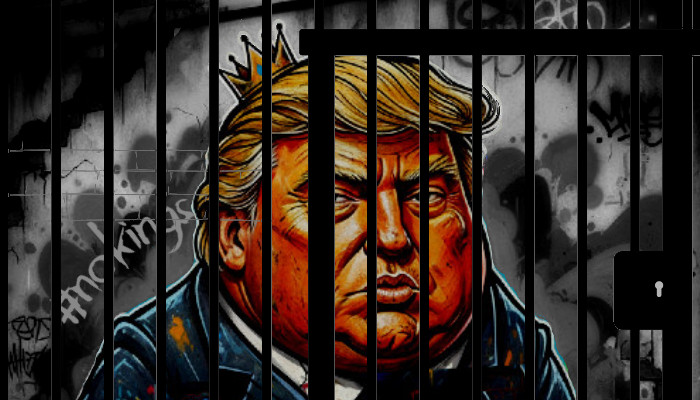
The president of the United States has just publicly murdered eleven people. He committed first-degree murder eleven times, then bragged about it to the world. Then he said, “There’s more where that came from.”
It happened on Sept. 2, a day that should go down in infamy. Donald Trump ordered the U.S. Navy to use ether a drone or a helicopter and destroy an unarmed Venezuelan speedboat with eleven people aboard because he believed it was carrying drugs, and he believed gang members were aboard, and he believed they were headed for the United States for nefarious reasons.
He believed. He did not know. He had evidence but no proof. He just believed. He gave his innocent-until-proven victims no chance to no chance to speak, no chance to defend themselves. Just kill and destroy.
And even if they had been guilty of smuggling drugs, smuggling drugs is not a capital offense. How else can you describe that as anything but open-and-shut first-degree murder?
Trump claimed the four-engine speed boat was loaded with drugs and the eleven men aboard were terrorists, members of the Venezuelan criminal gang called Tren de Aragua, which the US has designated as a terrorist organization. Therefore, he said, acting in the name of “protecting the national interest”, he had the power to invoke wartime rules that allow troops to lawfully kill enemy combatants on sight. Under normal civilian rules, law enforcement agents arrest criminal suspects for prosecution, but they cannot just gun down the suspects.
Does Trump have the power he claims?
Anna Kelly, a White House spokeswoman, read a statement that said the strike took place in international waters and did not put American troops at risk. She said Trump had directed the attack in “defense of vital U.S. national interests and in the collective self-defense of other nations who have long suffered due to the narcotics trafficking and violent cartel activities of such organizations.” She refused to take questions, including whether those other nations had asked him to defend them.
Supporters of the strike framed it as a necessary show of force. Sen. Lindsay Graham (R-S.C.), who once referred to Trump as “a kook”, called it “the ultimate – and most welcome – sign that we have a new sheriff in town.” Sen. Bernie Moreno (R-Ohio) wrote: “Sinking this boat saved American lives.”
But beyond all the rhetoric, legal experts and congressional sources say Trump has so far ducked lawmakers and provided a mishmash of public justifications that raise serious questions about the strike’s legality. CNN reported that the Defense Department abruptly canceled classified briefings that were scheduled to let the Trump administration explain itself to several key House and Senate committees. Lawmakers wanted to ask officials about the legal justification for the strike, and what intelligence gathering went into determining the identities and intentions of those on the boat. They got nothing.
Legal experts in the field agree that Trump had no right to invoke war rules and thus has committed murder. First-degree murder.
“It’s difficult to imagine how any lawyers inside the Pentagon could have arrived at a conclusion that this was legal rather than the very definition of murder under international law rules that the Defense Department has long accepted,” said Ryan Goodman, a New York University law professor who worked as a Pentagon lawyer in 2015 and 2016, in a New York Times interview.
Another doubter was Jeh Johnson, who served as the Pentagon general counsel and homeland security secretary in the Obama administration. Johnson noted that Congress had not authorized military force against cartels, and that under law congressional authorization is mandatory.
“Here the president appears to be invoking his amorphous constitutional authority to kill low-level drug couriers on the high seas, with no due process, arrest or trial,” Johnson said. “Viewed in isolation, labeling drug cartels ‘terrorists’ and invoking the ‘national interests’ to use the U.S. military to summarily kill low-level drug couriers is pretty extreme.”
Adam Isacson of the Washington Office on Latin America said the strike “looks like a massacre of civilians at sea. … ‘Not yielding to pursuers’ or ‘suspected of carrying drugs’ doesn’t carry a death sentence.”
In Venezuela, Diosdado Cabello, Venezuela’s Ministry of Interior, Justice and Peace, called the killings extrajudicial murders. And Venezuelan President Nicolás Maduro accused the U.S. of threatening regime change.
Trump will not be charged with murder, of course, because the Supreme Court granted him permission to commit whatever crimes he wished, and if his crimes related to his official duties he would be immune from prosecution. We can only wonder if the justices considered he might use that power to murder defenseless people.
One solution to our nation’s problem with narcotics is to legalize them. Make drug abuse a medical problem, which it truly is, and not a legal problem. Tax their sales and use some of the proceeds to loudly inform the public of the drugs’ dangers. Proceeds also could be used to operate addiction hospitals. Let the addicts pay for their own recovery. The idea has strong backing among many law enforcement officials. (For more information on this movement, go to LawEnforcementActionPartnership.org )
Otherwise, just keep the faith and keep on keeping on. Do whatever you can, and we will get rid of this humanoid, maybe sooner than later.
- Pentagon Official: Trump Boat Strike Was a Criminal Attack on Civilians
- Trump’s strike likely constitutes ‘murder’ under international law: legal expert
- Vice President JD Vance doesn’t ‘give a s***’ if you think lethal Venezuela boat strike was a war crime
- Extra-judicial military killing is not a legitimate answer to drug trafficking
- Trump’s Caribbean massacre: A naked crime of US imperialism
- Trump won’t get to heaven if he keeps murdering people on boats